parametric array loudspeakers
Research on parametric array loudspeaker transducers — highly directional sound sources utilizing nonlinear acoustics, stepped plates, and dual-domain metamaterials.
Principle
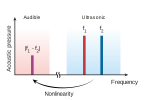
Unlike conventional loudspeakers that broadcast sound uniformly in all directions, Parametric Array Loudspeakers (PALs) act like an acoustic laser, projecting a highly directional beam of sound. This remarkable capability relies on exploiting the nonlinear acoustic properties of the air to convert high-frequency ultrasound waves into audible sound strictly along the beam’s path.

To generate a highly directional audio beam with a 4.5-degree half-power beam width at a frequency of 4 kHz, a massive radiating plate measuring approximately 21.5 inches (55 cm) in diameter would be required.
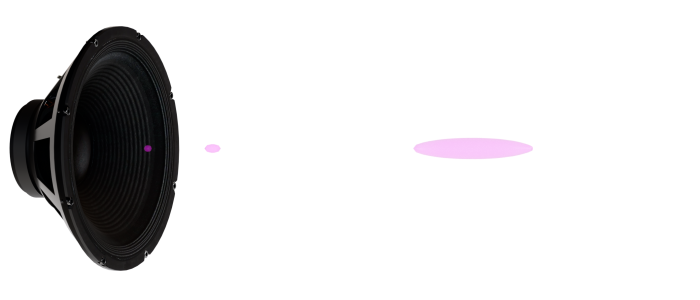
In reality, the diaphragms of conventional loudspeakers are not perfectly rigid but flexural. As the operating frequency increases, they exhibit complex vibration modes. This structural deformation prevents them from pushing the air uniformly, making it impossible to generate high sound pressure at high frequencies. For example, even a large 18-inch loudspeaker can only radiate sound effectively below approximately 400 Hz. This physical limitation implies that generating a truly directional audio beam through conventional direct radiation is practically impossible.

The concept of the parametric acoustic array was originally proposed in the seminal work of Peter J. Westervelt1. Building upon this foundation, PALs overcome these physical limitations, generating highly directional audio beams using a comparatively small radiating area. A PAL typically utilizes an ultrasonic transducer designed to emit a spatially coherent, planar wavefront. Because acoustic directivity is largely governed by the $ka$ parameter—the product of the wavenumber ($k$) and the radiator radius ($a$)—operating at high ultrasonic frequencies naturally yields a large $ka$ value. This physical advantage allows even a compact radiating surface to emit an intense, highly collimated beam of ultrasound. As this beam propagates, the nonlinear properties of the air act as a virtual array of audio sources, continuously demodulating the ultrasound into a narrow beam of audible sound in mid-air.


This remarkable effect occurs because the intense ultrasound waves alter the local density and sound speed of the air, causing the waves to interact with themselves and generate secondary audible sound. The mathematical foundation dictating this phenomenon is governed by the nonlinear wave equation2. It describes how high-pressure ultrasound waves undergo nonlinear interactions during their propagation, effectively forming a virtual end-fire line source in the air.
Radiators

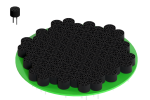

While an ideal rigid piston would be optimal, it is physically unfeasible to maintain uniform vibration across a large surface at ultrasonic frequencies. Consequently, traditional PALs are typically constructed using phased arrays comprising numerous small, synchronized transducers3. While effective, these phased arrays require complex and expensive driving electronics. This high cost and complexity pose significant barriers to the widespread commercialization of PAL technology. Alternatively, a single flexural vibrating plate offers a highly compact and cost-effective architecture.
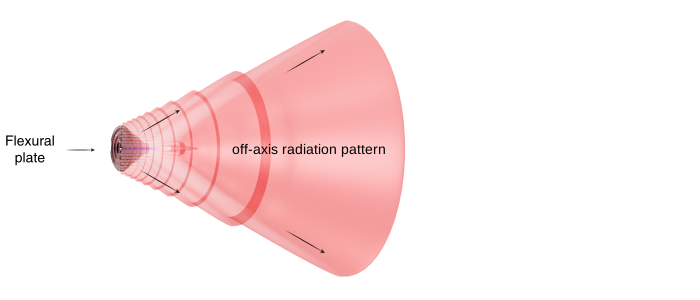
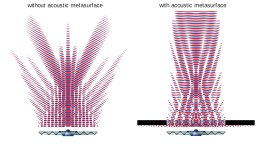
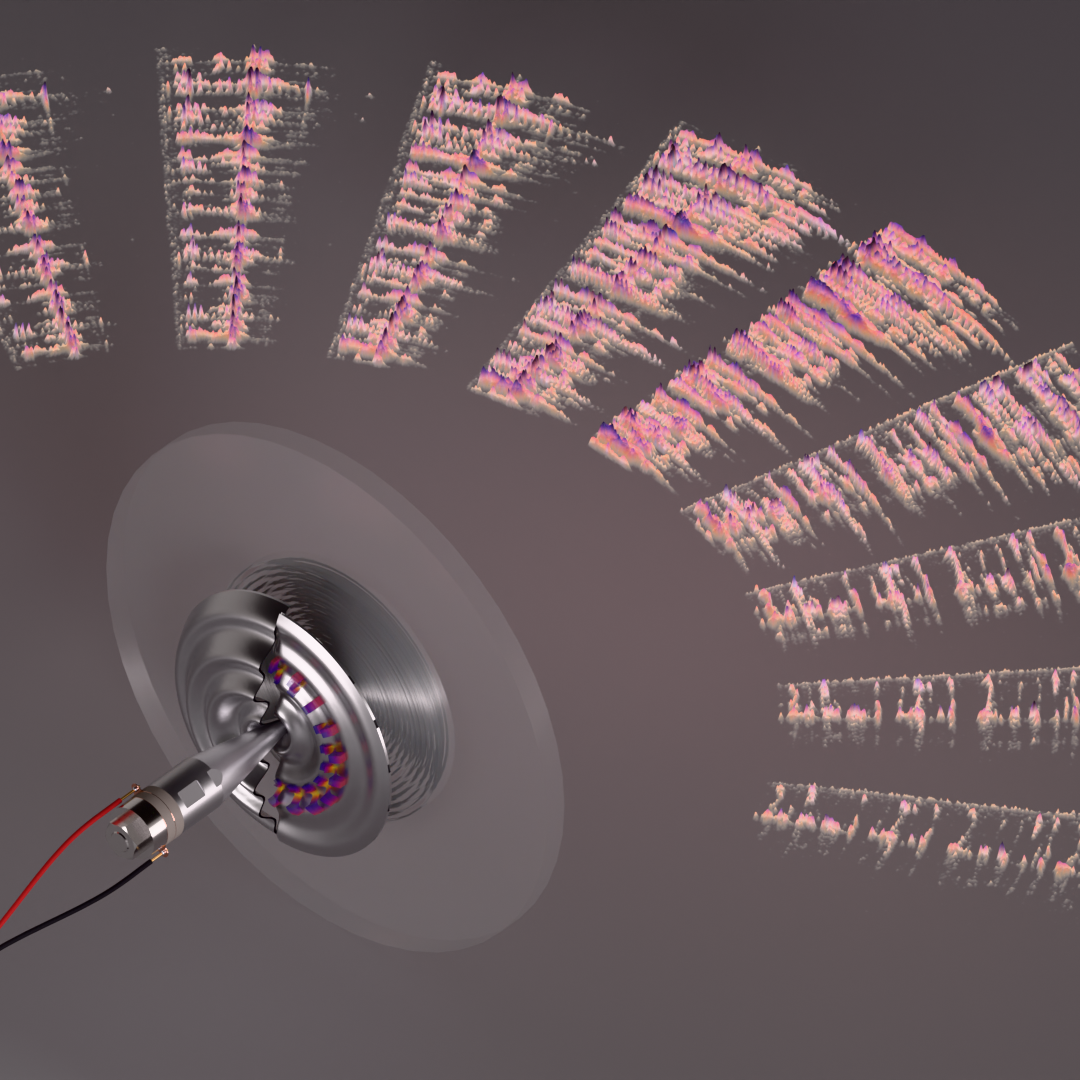
However, a standard flexural plate inevitably exhibits high-order vibration modes when driven at ultrasonic frequencies. As shown in the off-axis radiation pattern above, these complex structural vibrations produce an incoherent, scattered acoustic field, rendering it useless for generating a focused directional sound beam on its own.
Stepped-plate parametric array loudspeaker (SPPAL) (Kim et al., 2025)
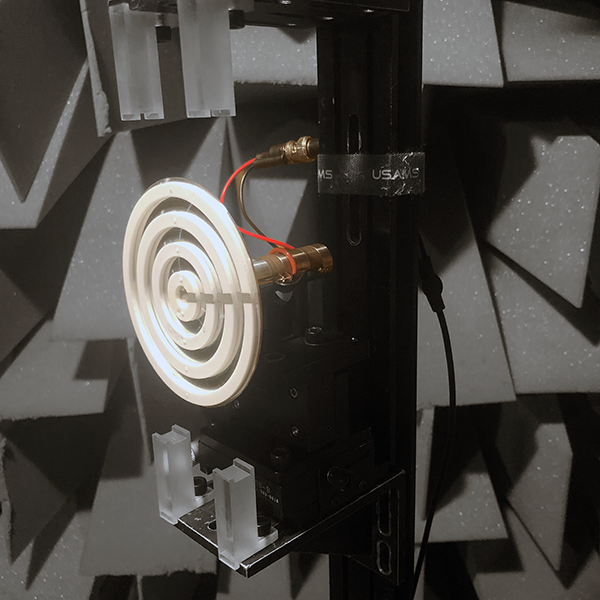
To resolve this scattering issue, the SPPAL was developed to transform the scattered radiation of a flexural plate into a collimated beam. By strategically attaching annular step rings onto the vibrating plate, the SPPAL applies precise phase delays to the radiated sound waves4. This simple yet effective modification aligns the phases of the emitted waves, allowing the single flexural plate to mimic the highly directional radiation of an ideal rigid piston.
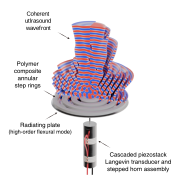


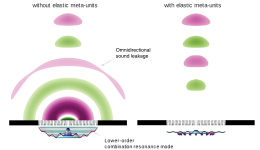
While the SPPAL successfully shapes the audio beam, experimental testing revealed an inherent challenge called combination resonance (CR). Due to structural nonlinear coupling with the low-order vibration modes of the flexural plate, even tiny driving forces excite the plate’s own structural resonances at audible frequencies. This undesirable structural vibration produces parasitic, omnidirectional noise, severely undermining the highly directional audio beam that the SPPAL was designed to achieve.
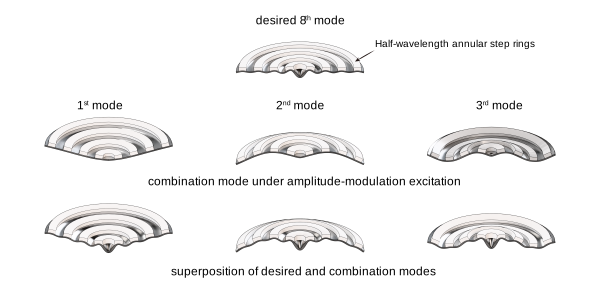
To understand the physical mechanism behind this limitation, consider the vibrational dynamics illustrated in the figure above. Under ideal, unmodulated ultrasonic excitation, the stepped plate vibrates purely in its intended high-order flexural mode (top), producing the spatially coherent wavefront required for a parametric array. However, a PAL is generally driven by an amplitude-modulated (AM) signal to generate audio. Due to the structural nonlinearity of the flexural plate, the low-frequency signal inadvertently excites the plate’s inherent low-order natural frequencies (middle). This phenomenon is known as combination resonance5. Consequently, during actual operation, the plate exhibits a superposition of the desired mode and the unwanted combination mode (bottom).
Research Contributions & Limitations
-
Establishing an integrated modeling framework successfully bridged structural dynamics with nonlinear acoustic propagation. Combining an approximate analytical 3D model6 with the spherical wave expansion (SWE) method7 enabled the accurate prediction of nonlinear acoustic fields without prohibitive computational costs.
-
Through multi-objective optimization, a dual-resonance (DR) transducer architecture was engineered to amplify both the primary carrier and sideband frequencies. This capability effectively compensates for the low-frequency roll-off inherent to parametric arrays, significantly enhancing the generated audio output.
-
Extensive vibration and acoustic measurements, run on a fully automated and synchronized test setup, systematically identified CR for the first time as an intrinsic structural limitation of single-body flexural transducers.
Metamaterials-integrated parametric array loudspeaker (MiPAL) (Kim† et al., 2026)
To overcome the limitations of the SPPAL—namely, its relatively low sound pressure and the parasitic noise caused by CR—the MiPAL co-integrates dual-domain metamaterials with a single-body ultrasonic transducer, addressing acoustics in the air and elastic vibrations in the structure simultaneously. A single piezoelectric driver takes the place of the tens to hundreds of emitters a conventional phased array requires.
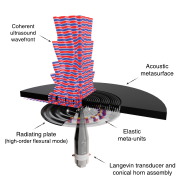


This architecture employs an acoustic metasurface to shape the scattered ultrasonic emissions into a collimated beam. Concurrently, locally resonant elastic meta-units integrated into the plate act as mechanical band-gap filters, suppressing the low-frequency structural vibrations responsible for CR. Experiments demonstrate a compact loudspeaker that delivers directional audio over four octaves, from 500 Hz to 10 kHz, without the omnidirectional leakage that limited the SPPAL.
Research Contributions
-
Co-integrating dual-domain metamaterials with a single piezoelectric driver established a compact directional-audio architecture that does not depend on a phased array of emitters.
-
Engineering an acoustic metasurface successfully overcame the severe material damping and low efficiency limitations of previous models. By replacing the heavy polymer steps of the SPPAL, this tailored layer redirects scattered ultrasonic emissions into a highly collimated sound beam.
-
Integrating locally resonant elastic meta-units directly onto the radiating plate introduces precise, mode-selective mechanical loss. This structural modification suppresses parasitic combination resonance modes, eliminating omnidirectional noise leakage and securing an ultrabroadband audio beam spanning over four octaves (500 Hz to 10 kHz).
References
-
P. J. Westervelt, “Parametric Acoustic Array,” J. Acoust. Soc. Am., vol. 35, no. 4, pp. 535–537, 1963. DOI: 10.1121/1.1918525. ↩
-
M. F. Hamilton and D. T. Blackstock (Eds.), Nonlinear Acoustics. Springer Cham, 2024. DOI: 10.1007/978-3-031-58963-8. ↩
-
J. Zhong and X. Qiu, Acoustic Waves Generated by Parametric Array Loudspeakers, 1st ed. Boca Raton, FL: CRC Press, 2024, pp. 295–299, 305–314. DOI: 10.1201/9781003354994. ↩
-
A. Barone and J. A. Gallego Juarez, “Flexural Vibrating Free-Edge Plates with Stepped Thicknesses for Generating High Directional Ultrasonic Radiation,” J. Acoust. Soc. Am., vol. 51, no. 3B, pp. 953–959, 1972. DOI: 10.1121/1.1912944. ↩
-
T. Yamamoto and S. Hayashi, “Combination Tones of Differential Type in Nonlinear Vibratory Systems,” Bull. JSME, vol. 7, no. 28, pp. 690–698, 1964. DOI: 10.1299/jsme1958.7.690. ↩
-
A. Iula, N. Lamberti, and M. Pappalardo, “An Approximated 3-D Model of Cylinder-Shaped Piezoceramic Elements for Transducer Design,” IEEE Trans. Ultrason. Ferroelectr. Freq. Control, vol. 45, no. 4, pp. 1056–1064, 1998. DOI: 10.1109/58.710588. ↩
-
J. Zhong, R. Kirby, and X. Qiu, “A Spherical Expansion for Audio Sounds Generated by a Circular Parametric Array Loudspeaker,” J. Acoust. Soc. Am., vol. 147, no. 5, pp. 3502–3510, 2020. DOI: 10.1121/10.0001261. ↩
Related works
2026
- Dual-domain metamaterials co-integrated with a compact ultrasonic transducer for highly directional audio generationNature Communications, May 2026Media coverage International
EurekAlert!
Tech Xplore
Nanowerk
Hackster
Ny Teknik
Techno
Digital Trends
Interesting Engineering
Gadget Review
Mapping Ignorance
DongA Science Korean
Yonhap News
The Dong-A Ilbo
The Kyunghyang Shinmun
YTN Science
Newsis
KPI News
Daegu MBC
Pohang MBC
TBC
Joongdo Ilbo
KIPOST
Newsworks
Gyeongbuk Maeil
Gyeongbuk Shinmun
Gyeongbuk Domin Ilbo
Gyeongbuk Ilbo
Daekyung Ilbo
Veritas Alpha
Korea University News Video
 YTN Science
  Pohang MBC Radio
 KBS 1Radio
2025
- Design, Analysis, and Experimental Validation of a Stepped Plate Parametric Array LoudspeakerThe Journal of the Acoustical Society of America, Sep 2025
Disclaimer: The contents provided on this page are for personal, academic, and non-commercial use only. Copyrights and all other rights are maintained by the respective authors or publishers. These materials may not be reposted without the explicit permission of the copyright holder.